Every contractor knows the feeling: you’re mid-project and the wrong tool slows everything down. Choosing the top 10 power tools every contractor needs means fewer delays, cleaner results, and more time focused on the work that matters.
Introduction
The right tools don’t just make projects easier. They protect your time, your reputation, and your bottom line.
Professional contractors face a different set of demands than weekend DIYers. Tools need to perform through full eight-hour shifts, handle tough materials, and hold up across hundreds of jobsites. Cutting corners on equipment costs far more in the long run.
The professional power tools market reflects this reality. According to Verified Market Reports, the global professional power tools market was valued at USD $26.55 billion in 2024. Knowing which tools belong in your kit, and why, is one of the most practical decisions you can make for your trade.
What Separates Contractor-Grade Tools from Homeowner Tools
Contractor-grade tools are built for daily eight-hour duty cycles in harsh conditions, and that is what separates them from consumer models. Professional tools handle a fundamentally different workload than occasional-use homeowner equipment, and that difference shows up in every spec.
Key distinctions include:
- Brushless motors: According to Grand View Research, brushless motors accounted for 60% of the cordless power tools market in 2024, driven by longer lifespan and reduced maintenance.
- Runtime advantage: For contractors using tools eight to twelve hours per day, brushless tools deliver 30-50% more work per charge, meaning fewer battery swaps and less downtime.
- Total ownership cost: Field testing data from Heavy Duty Journal shows premium contractor-grade tools deliver 40% lower total ownership costs over five-year periods compared to budget alternatives.
- Market dominance: According to Grand View Research, industrial and professional users represent 68.8% of 2025 power tools market value, reflecting how much contractors depend on purpose-built equipment.
Drills and Drivers: The Core of Every Contractor Kit
Drills and drivers define a contractor’s kit more than any other tool category. According to Precedence Research, the drilling and fastening segment is projected to hold 34.51% of market share in 2026, the largest of any tool type, making it the essential starting point for any professional toolkit.
Brushless Hammer Drill
A brushless hammer drill handles everything from wood framing to light masonry. It combines rotary drilling with a hammering action, making it the most versatile drilling tool on any jobsite.
According to a survey by Contractor Magazine, 84% of contractors use power drills as their most commonly used cordless tool. The same survey found that 84% of contractor respondents rely on 18V battery packs, making platform compatibility a key purchase decision. DEWALT® and Milwaukee® both offer strong 18V hammer drill options built for daily professional use.
Impact Driver
An impact driver delivers high rotational torque in short bursts, making it ideal for driving long screws and lag bolts quickly and safely without stripping fasteners.
Where a standard drill can bog down on heavy fastening tasks, an impact driver powers through. According to DataHorizzon Research, cordless impact drills held the largest market share among drill types in 2024, driven by their versatility for both fastening and drilling.
Pairing a hammer drill with an impact driver means you’ll spend more time working and less time switching bits.
Saws Every Contractor Reaches for Daily
Saws are among the tools contractors reach for most on any jobsite, and choosing the right one makes projects faster and safer. The wrong saw creates rework and risk. Cutting tools are non-negotiable, and matching the saw to the task is one of the most important decisions a contractor makes.
Circular Saw
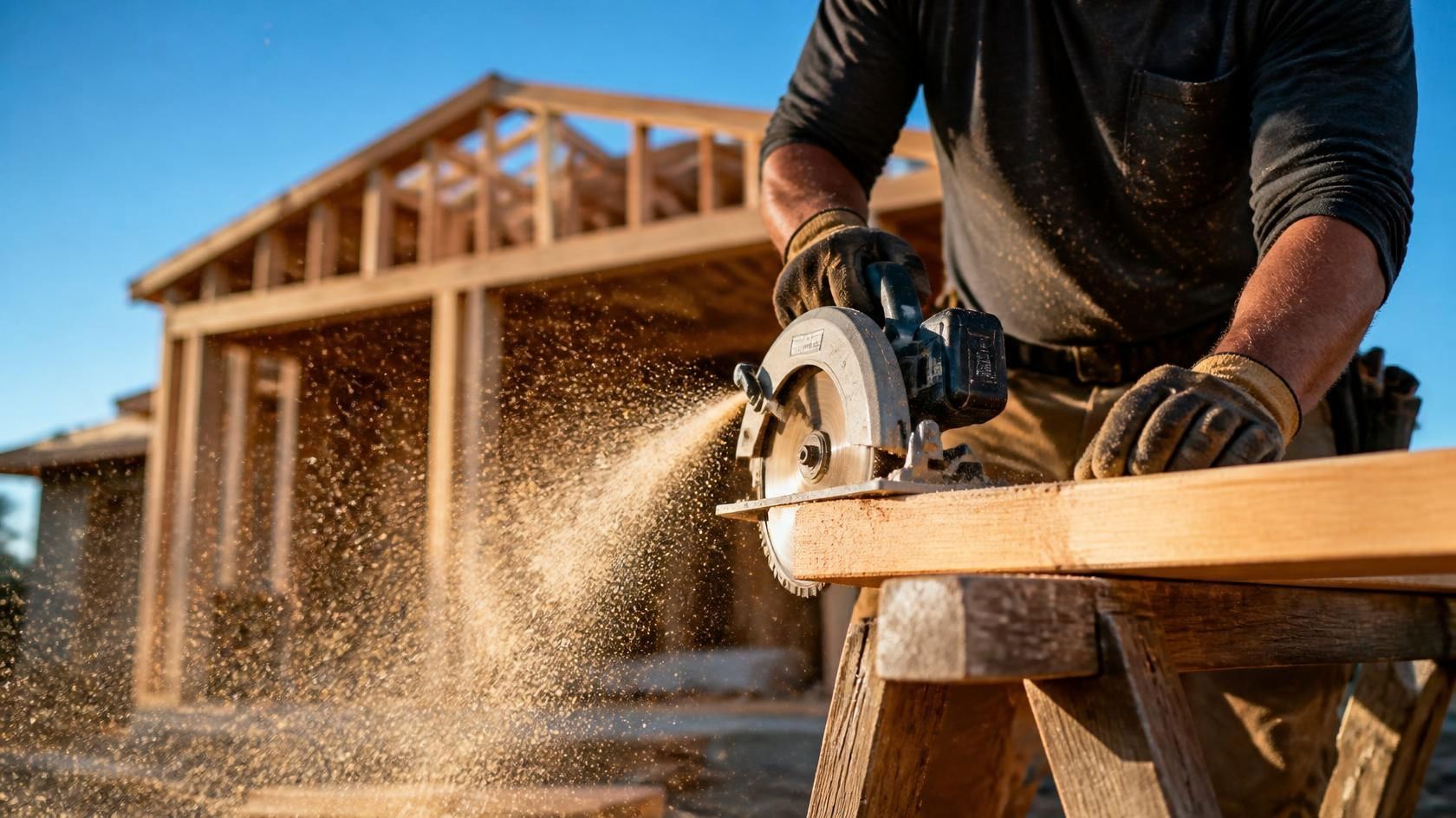
A circular saw is the backbone of framing, sheathing, and sheet goods work. According to Contractor Magazine, 86.6% of contractors use circular saws as one of their most-used corded tools, and 65% regularly use a cordless version.
The global circular saw market reached $11,017.30 million in 2024, according to Cognitive Market Research, reflecting sustained contractor demand. OSHA identifies three major hazards with circular saw use: point of operation, kickbacks, and flying particles. Contractor-grade models include anti-kickback features and blade guards that make it easier to work quickly and safely.
Reciprocating Saw
A reciprocating saw is the go-to tool for demolition, pipe cutting, and renovation tearout. It cuts through wood, metal, and drywall in tight spaces where no other saw fits.
According to Verified Market Reports, cordless reciprocating saws dominated with a 58.2% share in 2025. Contractor Magazine’s survey found 71% of contractors use a reciprocating saw regularly in cordless form, ranking it third among all cordless tools. Few tools make demolition projects easier than a quality reciprocating saw with the right blade.
Rotary Hammer: The Concrete and Masonry Specialist
A rotary hammer is the dedicated tool concrete and masonry work demands, because a standard hammer drill cannot deliver the impact energy needed for anchors, rebar holes, and structural penetrations. When the job involves concrete or masonry, a rotary hammer is the purpose-built specialist that gets it done.
SDS-Plus vs. SDS-Max: Choosing the Right Size
SDS-Plus rotary hammers handle most contractor applications: anchor bolts, conduit penetrations, and light chipping in concrete up to about six inches thick. They’re lighter and easier to maneuver in tight spaces.
SDS-Max models deliver significantly more impact energy for heavy demolition and large-diameter holes in thick concrete or stone. According to Research and Markets, more than 45% of professionals prefer rotary hammer drills for demanding masonry applications, citing unmatched performance versus standard hammer drills.
DeWalt launched a new 1-inch SDS-plus cordless rotary hammer in January 2025, delivering higher impact energy within its 20V MAX system. That makes it a strong option for contractors who need cordless flexibility on concrete work.
Cordless Band Saw and Angle Grinder: Pipe and Metal Work
Pipe and metal fabrication rely on two tools that work together: a cordless band saw and an angle grinder. The cordless band saw handles clean, precise cuts through pipe and conduit, while the angle grinder handles grinding, cutting, and surface prep on metal.
Key Specs for Each Tool
For a cordless band saw, look for these specs:
- Cutting capacity: At least 4-inch capacity for black iron pipe and EMT conduit
- Blade speed: Variable speed for cleaner cuts across materials
- Battery platform: Match to your existing 18V or 20V system
Milwaukee® Tool introduced next-generation deep cut band saws in September 2024 that cut 4-inch black iron pipes 20% faster than older models, according to Persistence Market Research.
For angle grinders, the battery-operated segment is projected to grow at 10.5% CAGR, reaching $1.2 billion by 2033, per Global Market Insights. Prioritize a grinder with a paddle switch and adjustable guard for safe operation.
Specialty Tools That Round Out the Professional Kit
Beyond the core tools, two specialty items separate a complete contractor kit from a basic one. These tools handle trade-specific tasks that no general-purpose tool can replicate.
Pipe Threading System
A pipe threading system is essential for plumbing and mechanical contractors working with steel pipe. Portable power drives like the RIDGID® 700 Power Drive thread pipe quickly and safely on the jobsite without requiring a shop setup.
Threading systems cut, ream, and thread pipe in one workflow. This makes projects faster and reduces the number of trips back to the shop. For contractors who handle gas lines, fire suppression systems, or industrial plumbing, a quality threading system is non-negotiable. Pairing the right die heads with your power drive produces clean threads and leak-free connections on every fitting.
Hydraulic Knockout Punch Kit
A hydraulic knockout punch kit creates clean, precise holes in electrical panels, enclosures, and sheet metal. Manual knockout punches work, but a hydraulic kit makes the job significantly faster on high-volume electrical projects.
“Tool theft is estimated at $1 billion annually for the U.S. construction industry, making Bluetooth-enabled tracking tools an increasingly essential specialty for fleet managers.” – Construction Executive
Investing in quality specialty tools, and protecting them with tracking technology, keeps your kit complete and your projects on schedule.
How to Choose the Right Power Tool Brand for Your Trade
Brand selection matters more than most contractors realize. Once you commit to a battery platform, 68% of U.S. tool buyers make their second and third purchases within the same platform, according to the Hardware + Home Improvement Association (2025). Switching platforms later is expensive.
Key factors to guide your decision:
- Trade fit: A survey of 10,000 contractors found Milwaukee® dominates electrical and HVAC work, while DeWalt leads in carpentry and drywall, per Frontier Tradesman.
- Brand trust: The Lifestory Research 2025 America’s Most Trusted study ranked the top brands in order as: DeWalt®, CRAFTSMAN®, Bosch, and Milwaukee®, per Lifestory Research.
- Warranty coverage: Milwaukee® offers a 5-year warranty on most M18 FUEL tools, while DeWalt and Makita both offer 3-year warranties, with DeWalt extending to 7 years on select tools, according to Tool Box Buzz.
- Electrification readiness: DeWalt’s 2025 Power Pulse Survey of 2,200+ skilled workers found 94% of construction professionals feel ready to transition to fully electric-powered tools, per Contractor Supply Magazine.
Conclusion
Building the right tool kit takes thought, but the payoff is real. Contractors who invest in professional-grade equipment spend more time working efficiently and less time dealing with breakdowns, battery swaps, and rework. The tools covered here represent the core of what serious tradespeople rely on every day.
Starting with a strong battery platform and expanding from there is the smartest approach. The team at your local Rocky’s Ace Hardware can help you find the right tools for your specific trade, match your existing platform, and make sure your kit is ready for whatever the next project demands.
Frequently Asked Questions
How much does it cost to build a complete contractor tool kit in the United States?
Buying tools, batteries, and chargers separately costs 30-50% more than purchasing a combo kit, according to IndexBox. The multi-tool combo kit market is growing from $1.6 billion in 2025 to $2.9 billion by 2035, reflecting strong contractor demand for value-focused purchasing.
Starting with a two or three-tool combo kit within a single battery platform is the most cost-effective entry point for contractors in the United States.
Where do most contractors in the United States buy their power tools?
Most contractors, 59%, purchase power tools from industrial supply houses, followed by home centers at 51% and the internet at 37%, according to Contractor Magazine. Local hardware retailers with knowledgeable staff, like Rocky’s Ace Hardware, offer a practical advantage: expert guidance on platform compatibility and trade-specific tool selection that online purchasing can’t replicate.
How long do professional-grade power tools typically last?
Professional-grade tools are engineered for daily eight-hour duty cycles in demanding conditions. The global cordless rotary hammer drill market is growing at 8.5% CAGR, according to DataIntelo, driven partly by contractors replacing worn consumer-grade tools with purpose-built equipment.
Warranty length is a reliable durability indicator: Milwaukee®’s M18 FUEL line carries a 5-year warranty, while select DeWalt tools extend to 7 years.
How do Milwaukee® and DeWalt compare for professional contractors?
Both brands lead the professional market, but they perform differently by trade. A Pro Tool Reviews survey found Milwaukee® earned 33.3% of the vote for best cordless tools among professionals, per Pro Tool Reviews, while DeWalt leads in dollar market share at 28%.
Milwaukee® tends to dominate electrical and HVAC trades, while DeWalt is the preferred choice for carpentry and drywall work. Your trade should drive the decision.
What safety precautions should contractors take when using power tools daily?
Power tools account for roughly 400,000 emergency room visits annually in the U.S., according to Tool Troopers. The CDC estimates that nearly half of all construction workers have some level of hearing loss, and hearing damage can develop after using an electric drill for less than one minute, per BHHC Safety Center.
Hearing protection, eye protection, and proper blade guards are non-negotiable on any jobsite.