Many propane exchange operators buy inventory based on last year’s budget, not actual demand. That gap quietly drains cash. The case study below shows how tying capital spending to inventory turnover cut idle tank time from 27 days to 5 and unlocked real, measurable savings.
Introduction
A propane tank exchange program sounds simple: a customer drops off an empty cylinder and picks up a full one. Behind that transaction sits a capital-intensive operation with cylinders, cages, trucks, and refill infrastructure all competing for the same budget.
Most operators underestimate how much idle inventory costs them. Tanks sitting in staging yards are not generating revenue. They are tying up cash that could fund route expansion or equipment upgrades. This case study breaks down the structural problems that plague cylinder exchange programs and shows how one operational shift, tying capital expenditure to inventory turnover, produced outcomes that changed the economics of the entire model.
Why Businesses Explore Propane Tank Exchange Programs
Propane exchange is one of the few retail add-ons that generates recurring revenue with almost no daily labor required. The numbers back that up.
Retailers and operators are drawn to the category for several reasons:
- Market size: The U.S. propane tank exchange services market was valued at $1.2 billion in 2024, with the global market reaching $5.9 billion.
- Consistent demand: There are approximately 70 million gas grills in use across the United States, creating a reliable consumer base.
- Grill market growth: Gas grill sales are projected to reach $1.73 billion by 2025, a 46% increase from 2015 levels.
- Sustainability story: Leading exchange providers recycle hundreds of thousands of tanks from landfills every year, giving retailers a genuine environmental message to share with customers.
- Higher basket sizes: Exchange customers tend to spend more per visit because the trip is planned and destination-driven.
How a Propane Tank Exchange Program Works
The exchange model is straightforward for the customer. The operational complexity lives behind the cage.
The Retail Cage Model
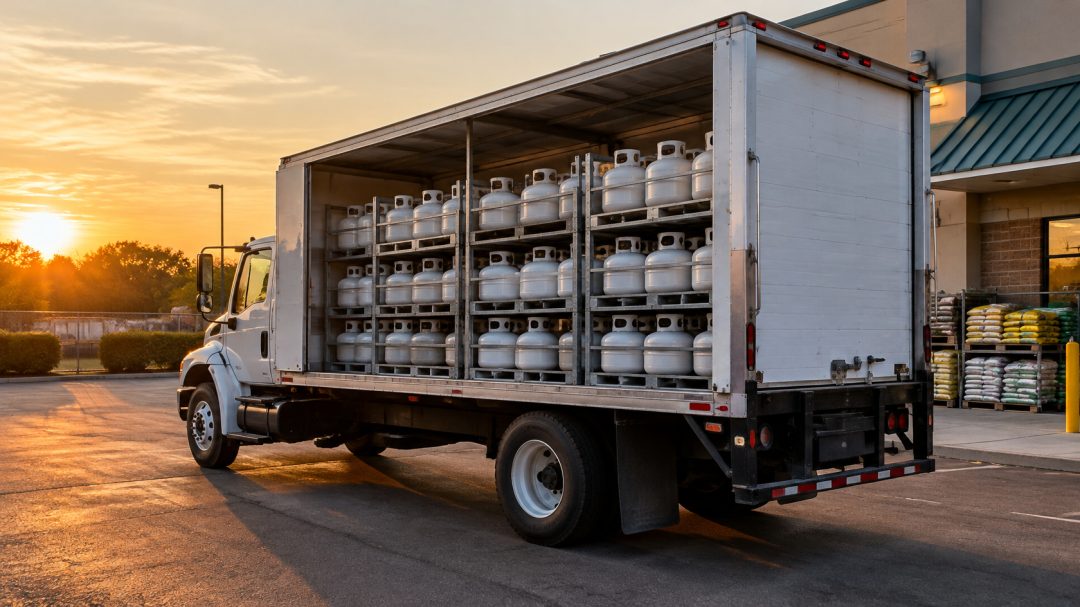
Most exchange programs run on a consignment basis. The exchange partner supplies the cage, the cylinders, and the refill inventory. The retail host provides outdoor space and handles the register transaction. According to NRS Plus, this structure makes setup accessible for smaller retailers because the operator absorbs the capital cost upfront. Blue Rhino alone operates at over 63,267 tank exchange selling locations across home centers, grocery stores, hardware stores, and convenience locations.
Tank Refill and Inspection Cycle
Every tank that re-enters circulation goes through a rigorous process before it reaches a customer. Blue Rhino’s refurbished exchange tanks pass through a 12-step proprietary process that includes surface blasting, repainting, precision fill-weight verification, and infrared leak testing. Each cylinder receives a quality-inspection sleeve before it ships back out. Exchange programs typically offer 20 lb, 30 lb, and 2 lb cylinders to cover grilling, heating, and recreational fuel needs.
The 80/20 Rule in Propane Tank Exchange
The 80/20 rule is not a business guideline. It is a physics-driven safety requirement built into federal code.
Liquid propane expands roughly 1.5% in volume for every 10 degrees Fahrenheit of temperature rise. Leaving 20% of the cylinder as vapor-expansion headspace prevents dangerous overpressure. The NFPA LP-Gas code caps cylinder filling density at 42% of the tank’s water capacity by weight, which works out to roughly 80% of volume. That makes the rule a compliance requirement, not just a best practice. Operators who ignore it face real liability exposure.
The CapEx Misalignment Problem This Case Exposed
Capital spending in cylinder exchange tends to follow habit rather than data. That habit is expensive.
The structural problem breaks into two distinct patterns.
Buying to Budget, Not to Demand
Many exchange operators purchase the same cylinder volume year after year, regardless of what sales actually require. Blue Rhino’s own early history illustrates the trap at scale. The company initially built a vertically integrated operation, purchasing and leasing cylinders, display cages, filling sites, and delivery vehicles, before pivoting to a more capital-efficient model. That pivot included an automated bottling and refurbishing plant with an aggregate investment of approximately $6.0 million. Buying to last year’s budget line, rather than to actual turnover data, is what forces those expensive corrections.
The Hidden Cost of Idle Inventory
Startup CapEx for an independent exchange route ranges from $50,000 to $200,000, depending on cage count and whether filling is outsourced. Most of that capital ends up “in the field,” exposed to loss, expiry, and idle dwell time. Demand is seasonal, peaking in summer and supplementing in winter, but cylinders, cages, trucks, and insurance are year-round fixed costs. That seasonal timing mismatch compounds asset underutilization during off-peak months and quietly erodes margins.
Challenges Every Cylinder Exchange Operator Faces
Running a cylinder exchange operation means managing compliance, route economics, and asset loss simultaneously. None of those challenges are small.
Regulatory and Safety Requirements
Compliance standards are actively evolving. The NPGA Cylinder Exchange Council is currently focused on updating NFPA 58 requirements for inspecting face seals on cylinder valves and working with NIST on cylinder tare weight data collection. A 2022 NIST national survey of over 10,000 cylinders found that 25.8% of all exchange lots tested failed net content compliance, meaning regulatory pressure on fill accuracy is not easing.
Route Economics and Breakeven Thresholds
The U.S. cylinder exchange industry has fewer than 1,000 cylinder delivery units on the road today, collectively serving roughly the same customer volume as a single soft drink distributor. Route density matters enormously. A swing of just three swaps per week across 35 cages at $14 gross profit per swap equals approximately $76,000 in gross profit variance per year before route costs. Thin routes do not break even.
Tank Loss, Theft, and Shrinkage
Asset management is the central discipline in cylinder exchange. As BPN News puts it directly: “If operators do not have strong control over cylinder assets, they do not have strong control over their exchange business.” Forecasting replacement cylinders and valves is genuinely difficult because managers cannot accurately predict how many tanks will need to be scrapped each cycle. Supply chain constraints make that forecasting problem worse.
How Tying CapEx to Inventory Turnover Fixed the Model
The fix is not complicated. It requires discipline rather than new technology.
Blue Rhino provides the clearest public case study. In fiscal 2024, the company decreased capital expenditure by nearly $8.0 million specifically because of supply chain improvements and inventory turn improvements. The mechanism was direct: removing multiple days of supply across the nationwide network produced a material improvement in free cash flow. Ferrellgas confirmed it “was able to increase inventory turns and implement supply chain tweaks at its production facilities to continue to drive down CapEx expense, which then increases cash flow.” Every day of idle inventory removed converts into freed capital.
Measurable Outcomes: From 27 Days Idle to 5
Reducing idle tank time is not a theoretical benefit. The results show up in revenue and cash flow.
Key outcomes from operators who made this shift include:
- Service speed: Blue Rhino reported a 25% decrease in time to service during Q2 fiscal 2025 compared to the prior year, combined with 6,000 added selling locations driving 14% organic sales growth.
- Transportation savings: The Pinnacle Propane case study, covering 60,000+ customer locations, showed a 15% reduction in annual transportation costs, saving over $800,000 per year, after tying replenishment planning to daily demand data.
- Forecast accuracy: The same Pinnacle deployment improved forecast accuracy by 25%, with a single forecasting manager running the entire network.
- Zero wasted truck rolls: Budget Propane’s IoT sensor deployment eliminated all manual tank-level check trips, freeing delivery capacity for productive cylinder turns.
- EBITDA impact: Ferrellgas’s overall Adjusted EBITDA increased $13.3 million to $330.7 million in fiscal 2025, with inventory turn improvements contributing materially to that result.
Should You Start or Scale a Cylinder Exchange Program?
The global propane tank exchange market is projected to grow from $5.9 billion to $10.1 billion by 2033 at a 6.2% CAGR. The opportunity is real. So are the entry requirements.
Key considerations before starting or scaling include:
- Network density: AmeriGas covered over 47,000 retail locations in fiscal 2024. Retail density is the dominant competitive moat. New entrants need high-traffic accounts to make routes viable.
- Startup capital: Independent routes require $50,000 to $200,000 in startup CapEx, with SBA 7(a) financing available for qualified operators under NAICS 454310.
- Independent benchmarks: Panhandle Propane started with under $5,000 and grew to a 100,000-gallon-per-year enterprise with $1.2 million invested over 8 years and 3,000 customers, with 95% of business in 20 lb cylinder exchange.
- Year-round demand: According to BizBite.io citing HPBA data, 86% of U.S. households own a grill or smoker, and 63% of grillers use their equipment year-round, making exchange a 12-month revenue opportunity.
- Automation options: Blue Rhino has installed over 500 self-service automated kiosks, and operators using unmanned exchange report significant cylinder sales growth without added labor costs.
At Rocky’s Ace Hardware, our team is happy to talk through what a propane exchange setup looks like at the store level. The right tools and the right partner make it easier to get a program running quickly and safely, so you can spend more time focused on serving your customers.
Conclusion
Propane tank exchange programs offer genuine recurring revenue, but the capital structure punishes operators who buy to budget rather than to demand. The case studies here show that the fix is available to any operator willing to tie purchasing decisions to actual inventory turnover data.
The category is growing globally, independent success stories are well documented, and the operational levers are understood. Whether you are evaluating a first cage or scaling an existing route, the principles are the same: track your cylinders, measure your idle time, and let turnover data drive your capital decisions.
Frequently Asked Questions
How much does it cost to start a propane tank exchange program in the United States?
Startup CapEx for an independent cylinder exchange route in the United States typically ranges from $50,000 to $200,000, depending on cage count and whether filling is outsourced to a third party. Established routes earn roughly $75,000 to $750,000 annually at approximately 25% SDE margins. SBA 7(a) loans are available for qualified operators under NAICS 454310, with median implied deal sizes around $47,000 for smaller entry-level operations.
How does the United States propane tank exchange market compare to global demand?
The U.S. domestic market has faced a revenue decline at an estimated CAGR of -4.2% between 2019 and 2024, driven by fragmentation and competition from alternative fuels. Globally, the picture is more positive, with the market projected to reach $10.1 billion by 2033. North America still holds the largest regional share at $2.7 billion, meaning U.S. operators benefit from the strongest existing retail infrastructure even as domestic growth moderates.
How much propane does an exchange tank actually contain?
Most national exchange programs fill 20 lb cylinders to only 15 lbs of propane, not the full amount the 80% safety rule permits. That is roughly 25% less propane than a full refill provides. A 2022 NIST survey of over 10,000 cylinders found that 25.4% of consumers return more than 1 lb of propane still inside their tank at exchange, meaning they surrender fuel they already paid for.
Is propane tank exchange safer than refilling at a standalone station?
Exchange tanks are inspected and refurbished before every recirculation, which provides a consistent safety baseline. In February 2024, the CPSC announced a recall of approximately 146,160 Worthington Enterprises exchange cylinders due to potential gas leaks, with no injuries reported at the time of recall. That outcome actually demonstrates the system working: the inspection process identified the issue before consumers were harmed.
What does a tank need to qualify for exchange?
Any standard 20 lb propane cylinder must have an OPD (Overfilling Prevention Device) valve, identifiable by its three-pronged handle stamped “OPD,” and be in proper operating condition. Tanks without OPD valves cannot legally be refilled or exchanged. One practical advantage of exchange over refill is that most exchange programs accept tanks past their 10-year recertification date, while refill stations often cannot legally fill expired cylinders.