Home design is evolving fast, and window treatments are no exception. Homeowners across the United States are rethinking their windows as a design opportunity, not just a practical fix. Knowing the latest trends in custom window shade designs for homes helps you make smarter choices that last.
Introduction
Custom window shades have moved well beyond simple light blocking. Today they shape a room’s mood, improve energy efficiency, and reflect a homeowner’s personal style in ways that off-the-shelf options simply cannot match.
The global blinds and shades market reached USD $12.9 billion in 2025, according to IMARC Group. That growth is driven largely by homeowners who want treatments built to their exact specifications, not approximate standard sizes.
Getting window treatments right matters more than most people realize. A poorly fitted shade leaves light gaps, wastes energy, and dates a room quickly. The right custom solution, chosen with a little expert guidance, protects your investment for a decade or more.
What Custom Window Shades Actually Are
Custom window shades are made to exact measurements, typically precise to 1/8 of an inch, according to Victor Shade. That precision eliminates the light gaps and awkward fit that come with standard big-box options.
The difference in longevity is significant. Here is what the data shows:
Lifespan advantage: High-quality custom treatments last 10 to 20 years, while typical big-box mini blinds last only 2 to 4 years.
Market dominance: The residential segment commands 66.7% of the total blinds and shades market share in 2025, per Fortune Business Insights
Homeowner adoption: Approximately 72% of newly renovated U.S. homes installed customized blinds or shades, per OrangePiel
Energy focus: 44% of homeowners selected energy-efficient treatments specifically for insulation purposes
Top Custom Window Shade Styles Trending in 2026
Roller shades are leading the market in 2026, capturing a 51.9% share according to Coherent Market Insights. Their clean look and versatility make them a natural fit for modern interiors.
The top product categories dominating 2026 include:
Motorized roller blinds: Smart-ready and sleek, pairing well with minimalist interiors
Light-filtering and blackout roller blinds: Flexible light control for any room
Zebra blinds: Alternating sheer and solid bands for adjustable privacy
Cellular blinds: Strong energy performance with a clean profile
Roman blinds: Soft linen and rich velvet versions are resurging as warm, tailored options
Color is shifting too. Earthy tones like moss green, sky blue, forest brown, stony grey, and terracotta are replacing cool grays as the dominant 2026 palette, per World Wide Shades. Nature-inspired warmth is the direction.
Slim-Profile and Clean-Line Shade Designs
Slim-profile shades are gaining serious ground in 2026. Homeowners want treatments that disappear into the architecture rather than compete with it. Recessed cassette rollers, hidden hardware, and minimal brackets are all part of this shift.
This clean-line approach pairs naturally with the earthy color palette trending this year. The result is a window that feels intentional and calm. For anyone tackling a refresh project, slim-profile shades make it easier to achieve a polished, contemporary look without a full renovation.
Smart Shades: Automation Becomes the New Standard
Motorized shades are no longer a luxury add-on. The automated window shades market is projected to grow from $3.27 billion in 2025 to $3.58 billion in 2026, reflecting a CAGR of 9.4%, per EIN Presswire.
The 2026 North American residential market is forecast to split roughly 35 to 40% motorized, 30 to 35% cordless, and 20 to 25% corded, according to Sincerity Blind. Motorized is growing the fastest, gaining 5 to 7 percentage points year over year.
Key drivers behind this shift include:
Designer adoption: 56% of interior designers now specify motorized solutions for luxury homes.
Smart home integration: Matter 1.2 now certifies 20 window-covering devices for native compatibility across Apple, Google, and Amazon ecosystems
AI voice control: Somfy integrated with Josh.ai in May 2025, allowing natural language commands for motorized shades.
Urban demand: Motorized shade demand has increased by 55% among urban households adopting smart home ecosystems
Energy Savings from Motorized Custom Shades
Motorized shades do more than add convenience. They actively reduce energy costs by adjusting automatically based on sunlight, time of day, or occupancy. That kind of precision is hard to replicate with manual operation.
A study led by Oak Ridge National Laboratory found cellular shades saved up to 20% on heating energy and up to 15% on total heating and cooling energy compared to homes using no shades, per OSTI/DOE Research. Pair that performance with automation, and energy management becomes genuinely effortless.
Organic Materials and Texture in Custom Shade Design
Natural materials have become a defining feature of 2026 window treatment design. The fabric segment held a leading global market share of 43.67% in 2025 in the broader window coverings market, per GM Insights, driven by demand for texture, warmth, and flexibility.
Consumer interest in sustainable options is accelerating:
Gen Z preference: 65% of Gen Z consumers prefer eco-friendly materials like bamboo or organic cotton for window treatments, per WiFi Talents
Linen surge: The “Quiet Luxury” trend has led to a 25% increase in linen fabric sales for drapes and shades
Product launches: Eco-friendly curtain fabrics represented 36% of newly launched product collections during 2025, per Fortune Business Insights
Organic growth: Consumer demand evidenced a 20% growth in organic textile-based window covering offerings over the last two years, per A Shade Above VA
Textured Fabrics and Natural Materials
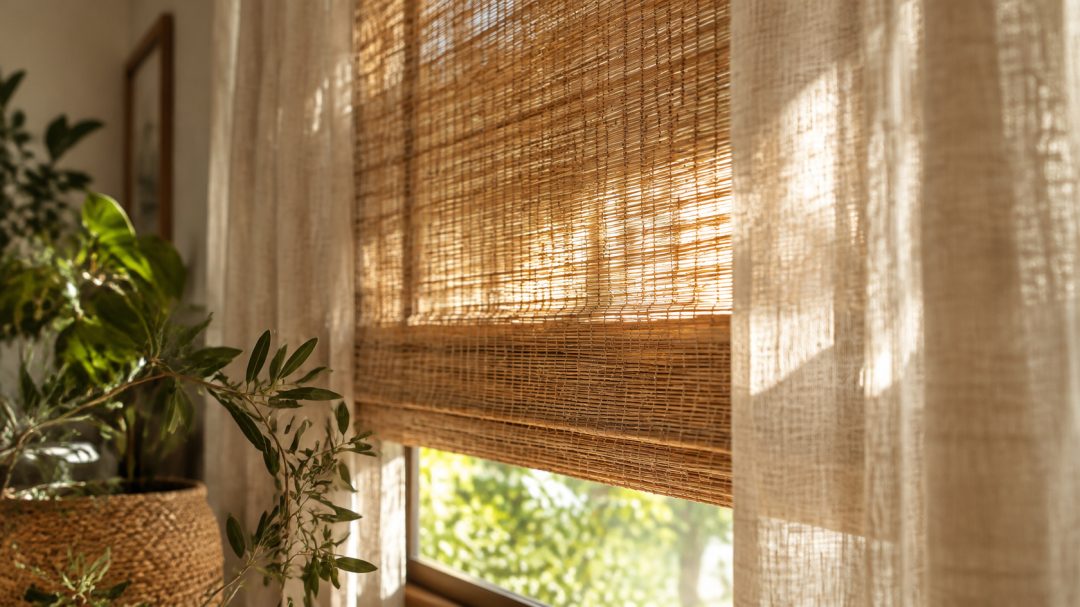
Woven wood, bamboo, and linen shades bring a tactile quality that painted walls and smooth surfaces cannot. They add depth without visual noise, which is exactly what the current design moment calls for.
“68% of respondents preferred natural materials and finishes in their home decor.” – Blinds to Go
For homeowners working on a refresh project, natural-material shades are one of the most rewarding upgrades available. They feel considered and calm, and they age gracefully.
Layered Window Treatments for Light Control and Privacy
Layering is the design strategy most often cited by industry professionals for maximizing both aesthetics and function. Interior designer and Graber executive Erica Flynn stated that “pairing sheers, shades, and drapery will dominate” 2026 window treatment design, adding both comfort and dimension, per AOL Lifestyle.
The practical case is strong too. Pairing sheer curtains with blackout shades can reduce heat loss by up to 40%, while blackout shades alone block up to 99% of incoming light.
Room-by-Room Layering Applications
Layering works differently depending on the room. Bedrooms benefit most from a blackout shade paired with a soft sheer, giving full darkness at night and diffused light in the morning. Living rooms often do better with a light-filtering roller shade plus drapery panels for warmth and texture.
Custom window treatment orders have increased by 12% among Millennial homeowners, with layered and dual-shade configurations identified as the primary driver. Getting the layering right for each room is where expert guidance makes a real difference.
Sustainability and Longevity in Custom Shade Choices
Energy performance is now a core reason homeowners choose custom. According to the U.S. Department of Energy, windows account for 25 to 30% of residential heating and cooling energy loss. Properly fitted custom shades are among the most cost-effective upgrades available.
Sustainable product development is accelerating too. Hunter Douglas launched a GreenScreen Sea-Tex collection in 2025, crafting eco-friendly blinds and shades from recycled ocean plastics, per Norman USA. Lifespan also matters: roller shades last 8 to 10 years, Roman shades 10 to 12 years, and natural wood blinds up to 20 years, per Stoneside.
Custom Shades for Oversized and Uniquely Shaped Windows
Oversized and floor-to-ceiling windows are one of the top design trends of 2025 to 2026, per Old World Roofing. They create a luxury feel and a strong connection to the outdoors, but they demand tailored treatments to manage glare, privacy, and energy loss.
Standard shades simply do not work for specialty shapes. A 2023 survey of major U.S. window covering retailers found that 10 to 15% of in-store consultations cited odd-shaped windows as the primary motivation for exploring custom options. Custom-shaped window manufacturing requires specialty tooling, with lead times of 4 to 10 weeks compared to 2 to 4 weeks for standard rectangular windows. That is a key reason in-store specialists provide a real advantage for these projects.
Trends That Are Fading Out in 2026
Some familiar styles are losing ground quickly. Designers are clear about what no longer works.
“While blinds were once a very functional light-filtering option, there are so many other options that look tailored, elegant, and beautiful.” – House Digest
The styles being left behind include:
Vinyl horizontal blinds: Functional but dated, being replaced by roller and cellular options with cleaner profiles
Standard honeycomb shades: Losing favor to more textured, natural-material alternatives
Metal grommet curtain rods: Design is trending more subtle and organic, per Yahoo Life
Ornate valances: The 1980s and 1990s layered valance look reads as cluttered in modern interiors
Cool gray and blue-gray palettes: Being replaced by warm neutrals like taupe, beige, and caramel, per Shades Industry Corps
Corded blind systems: Being phased out by both regulation and consumer preference
Conclusion
Custom window shades in 2026 reflect a broader shift in how homeowners think about their living spaces. Style, energy performance, smart technology, and sustainable materials are no longer separate priorities. They are all part of the same decision.
Choosing the right treatments for your home does not have to feel overwhelming. With the right guidance and the right tools, it becomes a project that pays off in comfort, efficiency, and lasting style. At Rocky’s Ace Hardware, our team is ready to help you find solutions that fit your windows and your life.
Frequently Asked Questions
How much do custom window shades cost in the United States?
Custom window shades in the United States typically range from $150 to $600 per window, depending on material, style, and features. Motorized setups average around $500 per window and can reach $2,500 for premium configurations. A typical eight-window project averages $760 when using mid-range motorized options.
Are custom window shades popular across the United States?
Custom window treatments are growing steadily across the United States. More than 68% of homeowners in developed economies installed blinds, shades, or curtains during interior remodeling projects in 2025, per Fixr. Among industry professionals, 73% cited customization options as an important purchase decision factor. Search interest for window blinds peaked at a score of 100 in June 2025, up 25% year over year.
What is the difference between cordless and motorized custom shades?
Cordless shades use a spring-loaded or tension mechanism for manual operation, while motorized shades use an electric motor controlled by remote, app, or voice command. Cordless window treatments now account for over 70% of retail availability, driven by residential safety regulations, per Couponzania. Motorized shades offer automation and smart home integration that cordless options cannot match.
How do custom shades compare to store-bought options for energy savings?
Custom shades outperform store-bought options significantly on energy performance. The precision fit eliminates the light and air gaps common with standard sizes. The U.S. Department of Energy notes that 38% of homeowners now prioritize treatments that reduce heat loss, per GM Insights. Cellular shades, in particular, deliver measurable heating and cooling savings when properly fitted to the window opening.
How long does it take to get custom window shades installed?
Standard custom window shades typically ship in 2 to 4 weeks after ordering, with installation taking a few hours per room. Specialty or uniquely shaped windows require 4 to 10 weeks due to custom tooling requirements. About 1 in 3 homeowners installs window treatments themselves to save costs, per WiFi Talents, though professional installation is recommended for motorized systems and oversized windows.