Not all keys are created equal, and not all of them can be copied at a hardware store kiosk. Knowing which types of keys can be duplicated saves homeowners time, money, and frustration before a lockout happens.
Introduction
Key duplication is one of the most common projects homeowners tackle, yet most people don’t realize how much variety exists in the key world. A standard house key copies in minutes. A modern car key with a transponder chip is a different story entirely.
Getting the right information upfront makes it easier to plan ahead, whether you’re making a spare for a family member or replacing a lost set. The wrong assumptions can lead to wasted trips or, worse, a costly emergency lockout.
Understanding which keys copy cleanly, which require professional equipment, and which carry real legal restrictions gives homeowners the knowledge to protect their property and their budget.
What Key Duplication Actually Means
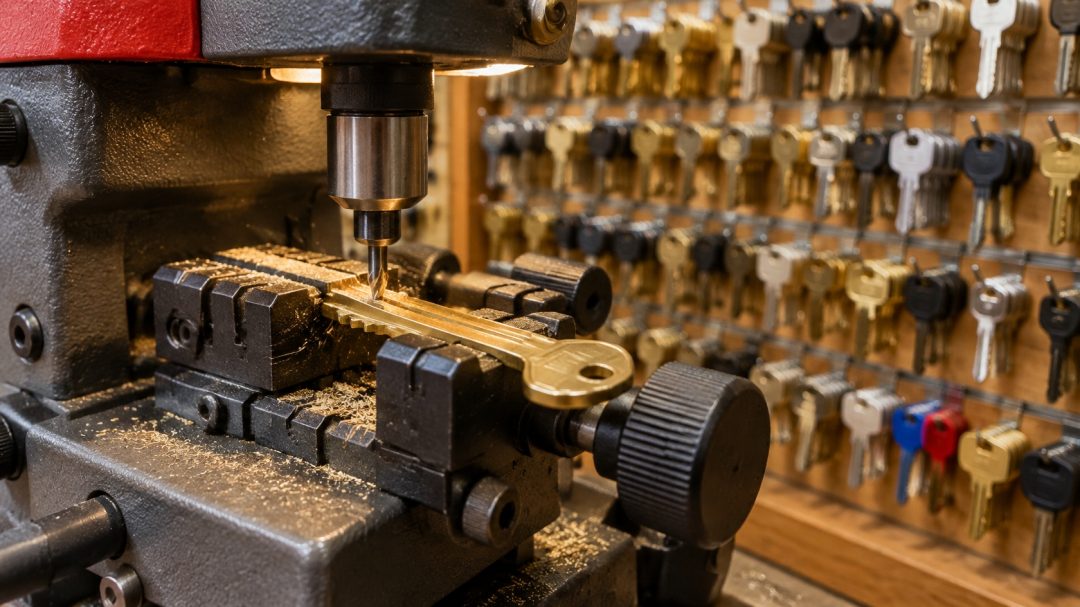
Key duplication means cutting a new key blank to match the profile of an existing key. For basic keys, this process is straightforward and fast. However, it varies significantly depending on the key type, with some requiring specialized equipment and others being effectively impossible to copy through standard methods.
A few important facts about how duplication works:
- Standard house keys can be duplicated in as little as 2-5 minutes at most hardware stores or self-serve kiosks, according to Wikipedia’s key duplication overview.
- Transponder car keys require electronic programming in addition to cutting, adding 15-30 minutes to the process.
- Smart key fobs take 45-90 minutes and require specialized software tools.
- Copy quality degrades over generations. A copy of a copy drifts from the original. By three or four generations deep, the cuts can damage locks. Always bring the original key, not a duplicate, according to Rocky’s Key Duplication FAQ.
- Standard house key duplication averaged $4.45 in 2024, with double-cut keys averaging $7.00, per the Locksmith Ledger National Average Price Survey.
Keys That Copy Cleanly: Standard Duplicable Types
Standard house keys, padlock keys, and basic office keys are the types that copy cleanly and quickly. A trip to a hardware store or kiosk is all it takes for these common key types. They require no special equipment, no authorization, and no electronic programming to duplicate safely and accurately.
Standard House and Apartment Keys
Standard house and apartment keys are the most common duplication projects. These single-sided or double-sided keys use a simple pin tumbler lock mechanism, and any qualified hardware retailer can cut them from a blank in minutes.
The process is fast, affordable, and reliable when you bring the original key. At Rocky’s Ace Hardware, staff can help match the right blank and cut a spare that works the first time.
Padlock, Cabinet, and Mailbox Keys
Padlock, cabinet, and mailbox keys follow the same basic principle as house keys. They use standard keyways and simple cut patterns that most key-cutting machines handle without any trouble.
These are ideal candidates for making spares before a key is lost. Mailbox keys in particular are easy to overlook until they’re gone, and replacement through a property manager can take weeks.
Car Keys Without Transponders
Traditional mechanical car keys, common in vehicles made before the mid-1990s, are among the easiest to duplicate. Any hardware store, locksmith, or self-serve kiosk can copy them, with replacement costs averaging $25-$100 and no programming required, according to Kwik Pick Locksmith.
If your vehicle is older and uses a plain metal key with no chip, duplication is straightforward. Bring the original, and a spare is ready in minutes.
Keys That Are Difficult or Impossible to Duplicate
Some keys are difficult or impossible to duplicate because they involve electronic components, patented designs, or specialized equipment that most standard retailers do not carry. Transponder car keys, high-security restricted keys, and smart keys all fall into this category, requiring a locksmith or authorized dealer rather than a typical hardware store or kiosk.
Transponder and Smart Car Keys
Transponder keys now dominate the automotive market. According to Future Market Insights, transponder keys hold a 91.8% market share in the global automotive key segment. More than 95% of new North American passenger vehicles are equipped with an engine immobilizer system, per Locksmith Ledger.
These keys use rolling code encryption, meaning the signal between the key and the car’s immobilizer may never repeat. Cloning them without OEM-level equipment is extremely difficult. Smart key fobs are even more complex, with programming costs ranging $180-$300 at a locksmith versus $400-$700 at a dealership, according to KeySolved.
Tubular, Four-Sided, and Abloy Keys
Tubular keys, used on vending machines, bike locks, and some older safes, require a specialized tubular key cutter. Most standard hardware stores don’t carry this equipment.
Four-sided keys and Abloy keys (a disc-detainer design common in high-security applications) are even more restrictive. These designs are engineered specifically to resist duplication. Copying them typically requires a locksmith with specialty equipment, and some designs are only available through authorized dealers.
The Truth About ‘Do Not Duplicate’ Keys
The “Do Not Duplicate” stamp on a key is not a legal restriction, it is simply a request that most retailers are free to ignore. Any hardware store or kiosk can legally copy a key bearing that label. Understanding what the stamp actually means matters for anyone managing home or business security effectively.
Restricted Keys: The Real Barrier
The Associated Locksmiths of America (ALOA) officially states that “Do Not Duplicate” keys are “not effective security” and that the wording is “deceptive because it provides a false sense of security,” according to Lock N More. There is no federal law prohibiting a locksmith or kiosk from copying a standard DND-stamped key.
Only California goes further, prohibiting duplication under Business and Professions Code Section 6980.54 when the key bears the originator’s company name and phone number, per GV Lock. In most states, the stamp is a request, not a rule.
High-Security Key Systems
True copy protection comes from patented restricted key systems, not a stamp. Brands like Medeco and Mul-T-Lock use patented keyways that require proof of ownership or an authorization card before any duplication can occur.
Copying a patented restricted key without authorization can trigger penalties of up to $10,000 under U.S. patent law, according to Allegion. The global high-security locks market reached $10.4 billion in 2024 and is projected to reach $20.1 billion by 2033, per Growth Market Reports, reflecting growing awareness of this distinction.
When to Duplicate vs. When to Rekey
Duplicating a key and rekeying a lock serve different purposes, and choosing correctly depends on your specific situation. Duplication makes sense when you need extra copies and trust everyone who currently holds a key. Rekeying is the better option when security has been compromised, a key is lost, or access needs to change entirely.
Here is a simple guide:
- Duplicate when you have a working original key, the hardware is in good condition, and the goal is giving a trusted person access or creating a spare.
- Rekey when a key was lost or stolen, someone’s access needs to be revoked, or you’ve moved into a new home.
- 74% of homeowners do not change their locks after moving into a new property, leaving them exposed to anyone who had a previous copy, according to Angi.
- Rekeying costs 60-80% less than full lock replacement. A full-house rekey runs $150-$400 versus $450-$900 or more for full replacement, per Angi.
- Making a spare now saves money later. An all-keys-lost car key job costs $100-$300 more than programming a spare while a working key still exists, according to KeySolved.
- Nearly 40% of car owners don’t have a backup vehicle key, per AAA Northeast, making spare key duplication one of the smartest low-cost projects any driver can tackle.
Conclusion
Key duplication ranges from a two-minute errand to a specialized professional service, depending entirely on the key type. Standard house keys, padlock keys, and older car keys copy easily and affordably. Transponder keys, smart fobs, and high-security restricted keys require professional equipment and, in some cases, proof of ownership.
The smartest move is to make spares before a key is lost, not after. A quick visit to a knowledgeable hardware retailer can save significant time and expense down the road. At Rocky’s Ace Hardware, staff are ready to help with key cutting projects and point you toward the right tools for whatever your home security needs.
Frequently Asked Questions
How much does key duplication cost in the United States?
Standard house key duplication is one of the most affordable home projects you can tackle, typically running under $10 for a basic cut. Double-cut and specialty residential keys average around $7.00. Transponder car keys cost significantly more, with automotive locksmith programming ranging from $80 to $250 depending on the vehicle, compared to $150 to $600 at a dealership for the same service.
Are there any states in the United States where copying a key is restricted by law?
Most states have no law specifically prohibiting duplication of a “Do Not Duplicate” stamped key. California is the notable exception, prohibiting duplication under Business and Professions Code Section 6980.54 when the key displays the originator’s company name and phone number. Patented restricted key systems carry separate federal protections under U.S. patent law, which apply nationwide regardless of state.
How many types of transponders exist, and why does that matter?
There are currently 45 or more different transponder types in use, with new ones introduced every year, according to Kwik Pick Locksmith. This variety is why automotive key programming is a specialized trade requiring dedicated equipment and software. By 2025, approximately 89% of vehicles globally used electronic key technologies, per DataIntelo, making professional programming increasingly common.
Can a locksmith program a car key, or do I need a dealership?
A qualified automotive locksmith can handle most car key programming jobs. By 2024, 67% of automotive locksmiths used cloud-based key-generation platforms, and 54% employed diagnostic scanners capable of reading and writing to a vehicle’s body control module, according to How To Be A Locksmith. Locksmiths are typically 30-50% cheaper than dealerships for the same service. Some late-model European luxury vehicles may still require dealer-only access.
What should I bring when getting a key duplicated?
Always bring the original key, not a copy of a copy. Key quality degrades with each generation, and a third- or fourth-generation duplicate can damage your lock. For car key programming, bring your vehicle title or registration as proof of ownership, especially for transponder or smart key jobs. For restricted high-security keys, an authorization card from the original key system is required before any duplication can proceed.