A dull knife is more dangerous than a sharp one. More than 340,000 people visited emergency rooms in 2024 with knife lacerations, and a blunt blade requires far more force to cut. Choosing the right sharpening method makes all the difference.
Introduction
Knife sharpening methods: stones vs machines is a question every home cook eventually faces. You notice the blade dragging instead of gliding, and suddenly a simple dinner project takes twice as long. Getting the edge back matters, but so does choosing the right approach for your situation.
Sharpening stones and electric machines each have genuine strengths. Neither is universally better. The right choice depends on your knife type, your skill level, and how much time you want to spend.
Understanding what each method actually does, and where each one falls short, makes that decision straightforward rather than overwhelming.
Why Knife Sharpening Matters (And When to Do It)
Dull knives are a genuine safety hazard in the kitchen. According to SeriouslyFastSharpening, a dull blade requires 3 to 5 times more downward force to cut, increasing slippage risk on wet or fibrous foods. That extra force is where most kitchen injuries happen, making regular sharpening a practical safety measure, not just a performance preference.
Knowing when to sharpen is just as important as knowing how:
- Daily use knives: Sharpen every 6 to 12 months, as recommended by America’s Test Kitchen and Wüsthof for home cooks.
- Occasional use knives: Once a year is often enough for blades used just a few times per week.
- Professional kitchen knives: Weekly or even daily sharpening keeps up with heavy workloads.
- The paper test: If a blade tears rather than slices cleanly through a sheet of paper, it’s time to sharpen.
- The visual check: Look for a rolled or reflective edge along the blade, which signals a misaligned or worn cutting surface.
Sharpening vs Honing: Two Different Jobs
Sharpening and honing are two different jobs, and confusing them leads to poor results and unnecessary wear on good knives. Sharpening removes metal to create a new edge, while honing realigns an existing one. Many home cooks treat them as the same task, but applying the wrong technique at the wrong time works against the blade rather than for it.
Here is how the two processes differ:
- Honing: Realigns the microscopic teeth along the blade’s edge without removing metal. According to Made In Cookware, done properly, honing can extend the functional life of a sharpened edge by up to 5 times.
- Sharpening: Removes metal to create a brand-new cutting edge. This is what whetstones and electric machines do.
- Frequency difference: Experts at Artisan Cutlery recommend honing weekly and sharpening every 6 to 12 months.
- The practical rule: As Sergio Menchaca of Texas Sage Forge puts it via tumblerware.com, “When you think you need to sharpen, you probably just need to hone it on a steel.”
Sharpening Stones Explained: Types and Grit
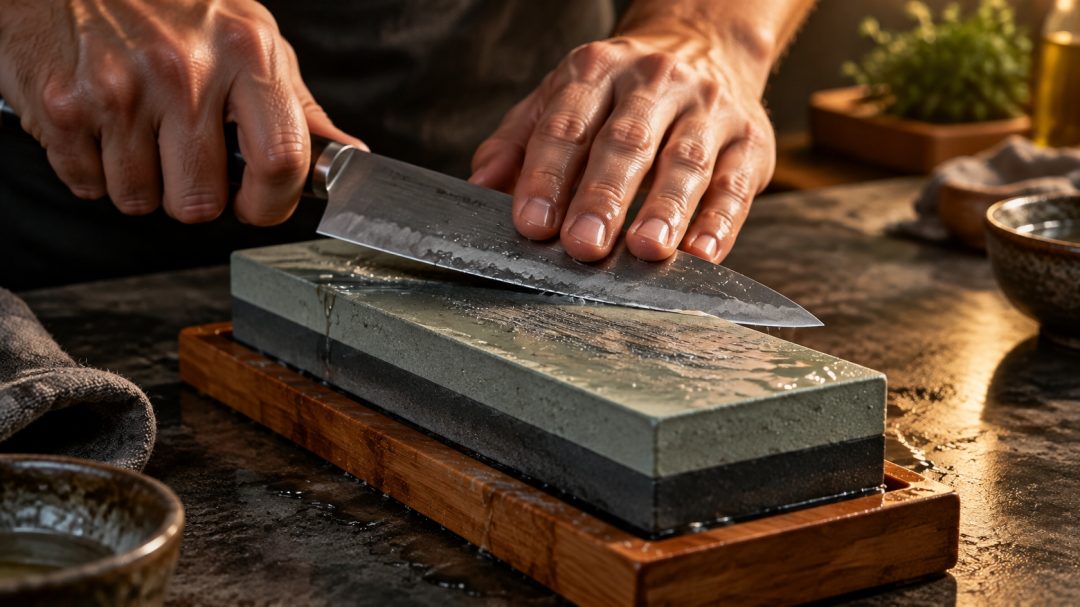
Sharpening stones are the gold standard for edge quality, offering a level of control and refinement that machines cannot replicate. The global whetstones market was valued at USD $457 million in 2024, a figure that reflects steady demand from serious home cooks and professionals who prioritize edge performance over convenience.
Types of Sharpening Stones
Sharpening stones come in four main materials, each with different performance characteristics:
- Water stones (Japanese whetstones): Fast-cutting, widely available, and ideal for most kitchen knives. They require water as a lubricant and are the most popular choice for home cooks.
- Oil stones: Slower cutting than water stones, but very durable. Common in Western sharpening traditions.
- Diamond stones: The fastest-cutting option. Great for hard steels and quick touch-ups, though they can be aggressive on softer blades.
- Ceramic stones: Best for fine polishing and finishing work. Often used as a final step after coarser stones.
1000 Grit vs 6000 Grit: What the Numbers Mean
Grit numbers tell you how much metal a stone removes and how refined the final edge will be.
According to KnifeCareHub, the standard grit categories break down like this: coarse (80 to 400) for chip repair, medium (1,000 to 2,000) for general sharpening, fine (3,000 to 6,000) for polishing, and ultra-fine (8,000 to 30,000) for a mirror finish. A 1,000-grit stone is the industry workhorse, removing enough metal to set a new edge quickly while leaving a finish smooth enough for everyday kitchen use.
A 6,000-grit stone refines that edge to a razor polish. According to SharpeningMadeEasy, 90% of knife owners only need a 400 to 600 grit stone and a 1,000 to 2,000 grit stone to cover virtually all home sharpening scenarios.
Sharpening Machines Explained: Electric and Pull-Through
Machines make sharpening faster and more accessible, especially for cooks who don’t want to spend time learning stone technique. The global electric knife sharpener sub-market is valued at $605.6 million in 2025, with electric models accounting for over 70% of knife sharpener market share.
Electric Knife Sharpeners
Electric sharpeners use motorized abrasive wheels to grind a new edge quickly and safely. According to America’s Test Kitchen, the top-rated Chef’sChoice 15XV Trizor produces a polished, razor-sharp edge in approximately 2 minutes. Most electric units complete a full sharpening session in 75 to 105 seconds, making them the fastest option available.
They work best on standard Western-style knives and are ideal for cooks who want consistent results without a learning curve.
Pull-Through Sharpeners
Pull-through sharpeners are the most affordable and convenient option, but they come with real trade-offs.
These devices use a fixed-angle V of crossed rods and typically retail for $10 to $50. According to Chef’s Armoury, pull-through sharpeners remove 2 to 3mm of metal per sharpening session, compared to just 0.5 to 1mm for professional hand sharpening. After 10 uses, a blade can be noticeably shorter.
Most pull-through models are set at a fixed 20-degree angle, which means they permanently damage Japanese knives that require a 12 to 15-degree bevel. For standard Western knives used occasionally, they’re a quick fix. For quality knives, they’re a risk.
Stones vs Machines: Where They Diverge
Choosing between stones and machines comes down to three factors: your knife type, your skill level, and how much time you can realistically commit to the process.
Which Method Suits Which Sharpener
Each method has a clear home. According to KnifeCareHub, only 18% of households using whetstones achieve reproducible 17-degree bevels even after six months of regular practice. A guided electric sharpener, by contrast, achieves 90% or more of optimal geometry with essentially zero skill requirement.
“67% of home cooks abandon their sharpening tools within six months because they chose the wrong method for their skill level.” – KnifeCareHub
Stones reward patience and practice with a superior edge, especially for hard Japanese blades over 60 HRC, where electric sharpeners can generate heat that softens the steel. Machines reward consistency and speed for everyday Western knives.
Cost Comparison: What Stones and Machines Cost in the US
Price varies widely across sharpening methods, and the cheapest option isn’t always the most economical over time.
Here is a breakdown of typical US retail costs:
- Pull-through sharpeners: $10 to $50. The KitchenIQ 50009 Edge Grip is listed at $13.95 with over 97,700 Amazon ratings at 4.4 stars, per TechGearLab.
- Whetstones: $40 to $80 for a quality dual-grit combo stone. The Sharp Pebble 1000/6000 retails for around $40, while the Shun 3-Piece Whetstone System runs $154.95, according to Gear Junkie. A good stone is a one-time purchase that can last a lifetime.
- Electric sharpeners (consumer grade): $30 to $200. The Presto EverSharp runs about $48, while the Chef’sChoice 15XV Trizor retails at $165.99, per Men’s Journal.
- Professional sharpening services: Most US shops charge $5 to $15 per knife. A standard 8-inch chef’s knife typically runs $8 to $12, with Japanese or specialty blades commanding $15 to $30, according to SharpFinders.
“A $45 whetstone can extend each knife’s life by 50% or more due to minimal steel removal, while a pull-through sharpener shortens each knife’s life by roughly 30% over 10 years.” – KnifeCareHub
Conclusion
Stones vs machines is not a debate with one winner. Whetstones deliver superior edge quality and long-term value for cooks willing to invest time in learning proper technique. Electric machines offer speed, consistency, and ease for everyday kitchen use.
The best method is the one you’ll actually use. Matching your sharpening tool to your knife type, your skill level, and your routine makes kitchen projects safer, more enjoyable, and far less frustrating. At Rocky’s Ace Hardware, our team is always happy to help you find the right tools for your kitchen.
Frequently Asked Questions
How much does knife sharpening cost in the United States?
Professional knife sharpening services in the United States typically charge $5 to $15 per knife at walk-in shops. A standard chef’s knife runs $8 to $12, while Japanese or specialty blades can cost $15 to $30 per sharpening.
The U.S. knife sharpening services market was valued at $89.2 million in 2024 and is projected to reach $135.9 million by 2030, reflecting growing demand from home cooks investing in quality knife care.
Are whetstones or electric sharpeners more popular in the United States?
In the United States, electric sharpeners currently represent 54% of unit sales, while manual devices hold 46%, according to DataIntelo. Despite this, Consumer Reports testing found that the Sharp Pebble whetstone produced an edge that none of the electric or manual sharpeners they evaluated could match.
Popularity and performance don’t always align, which is why understanding your own needs matters more than following market trends.
How long does a sharpened knife edge actually last?
Edge retention depends on steel quality and usage frequency. High-carbon steel at 60 to 62 HRC stays sharper 30 to 50% longer than budget steel. For a home cook using a knife daily, a professionally sharpened edge typically lasts 1 to 3 months.
For occasional use of once or twice per week, that same edge can last 6 to 12 months before the blade needs attention again.
Can I use an electric sharpener on a Japanese knife?
Using a standard electric sharpener on a Japanese knife is strongly discouraged. Most electric sharpeners are preset at angles designed for Western knives and cannot match the 12 to 15-degree bevel that Japanese blades require.
Beyond the angle mismatch, the heat generated by motorized abrasive wheels can soften hard steel over 60 HRC or cause micro-fractures along the blade. A whetstone is the correct tool for Japanese knives.
How long does it take to sharpen a knife with a stone versus a machine?
Electric sharpeners complete a full sharpening session in roughly 45 to 105 seconds, with touch-ups taking as little as 15 seconds. Whetstone sessions for a moderately dull knife average 10 to 15 minutes for a home cook, rising to 30 to 45 minutes for hard Japanese blades requiring a full grit progression.
The speed difference is real, but whetstone users gain a level of control and edge quality that machines cannot replicate.