
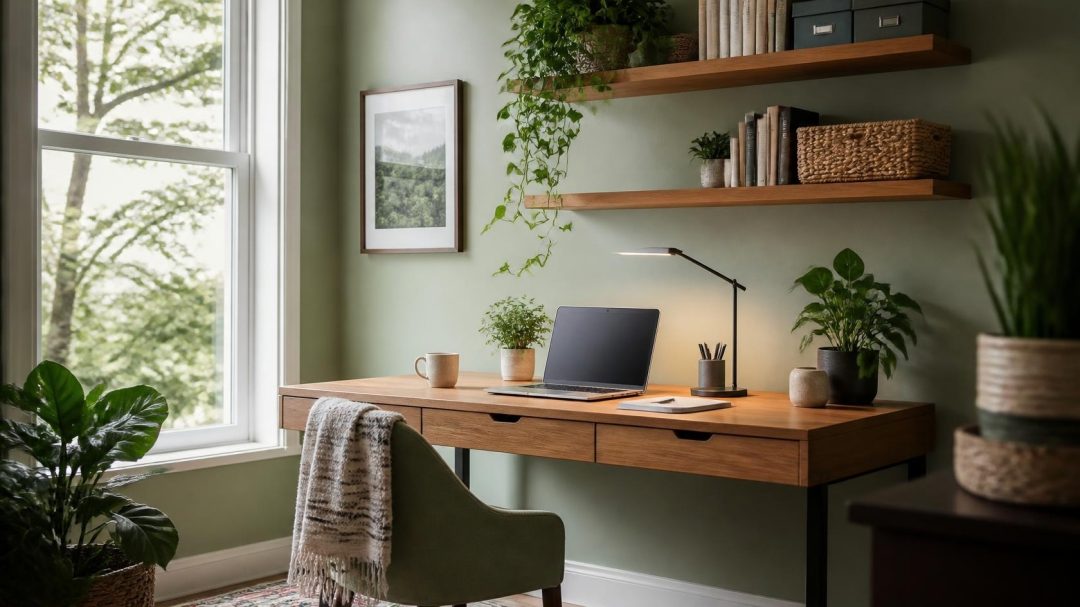
Your home office might be the most-used room in your house right now. A stale, cluttered, or poorly lit workspace drains focus and energy every single day. The good news is that a smart refresh does not require a full remodel.
Introduction
Remote work has reshaped how Americans use their homes. As of 2025, approximately 32.6 million Americans work remotely, representing 22% of the workforce. That makes the home office one of the most important rooms to get right.
A poorly designed workspace costs more than comfort. Research from Cornell University’s Human Factors Lab shows that environment factors account for a 5-15% variation in hourly productivity. That gap adds up fast over a full year.
The right refresh does not have to be expensive or complicated. Three focused updates, color and decor, lighting, and organization, can transform how your office looks and feels without tearing down a single wall. Getting these right makes every workday easier.
Why Your Home Office Deserves a Refresh
A well-designed office is not a luxury. It is a performance tool. According to a study published in the Journal of Environmental Psychology, employees in well-designed offices reported 33% higher wellbeing and 32% greater productivity compared to those in poorly designed spaces.
The numbers make the case clearly:
- Remote workforce size: 22% of all U.S. workers now work remotely full-time, making home office quality a daily issue
- Focus impact: 74% of U.S. remote workers say their office setup directly impacts their focus, per a FlexJobs 2024 Report
- Engagement crisis: Global employee engagement dropped to 20% in 2025, the lowest since 2020, with uninspiring environments a key driver
- Productivity range: Cornell research links office environment to a measurable 5-15% swing in hourly output
The Real Cost of Remodeling vs. a Simple Refresh
A full home office remodel averages $15,000, ranging from $5,000 to $25,000 for most homeowners. Converting a garage or adding a room can run $25,000 to $140,000. That is a significant investment for a space that might just need a fresh coat of paint and better lighting.
Smarter alternatives exist at every budget:
- Mini refresh: Paint, lighting updates, cable management, and small storage can be done for a few hundred dollars
- DIY conversion: A basic upgrade with paint, lighting, a desk, and a few outlets runs $2,000-$4,000 as a DIY project
- Budget risk: Nearly 37% of homeowners exceeded their renovation budgets in 2025, per Houzz
- Market signal: Only 13% of designers expect home office renovations to be their top-requested project in 2025, down from 32% in 2023, signaling a clear shift toward leaner refreshes
Way 1: Refresh with Color and Decor Strategically
Color is one of the fastest, most affordable ways to change how a space feels. Research shows color choices can influence productivity by up to 25%. A single weekend project with the right paint can shift your entire work mindset.
Choosing the Right Paint Color for Focus
Blue and green consistently outperform neutral tones in workspace research. Workers in blue offices completed tasks 25% faster with fewer errors, and reported 33% less anxiety and 25% less fatigue compared to white environments, according to DIG Interior Design.
White and grey offices are not neutral choices. They actively increase sadness by 25% and reduce energy by 30%. If your office walls are currently white or beige, a change to a soft blue or sage green is one of the highest-return projects you can tackle. Rocky’s Ace Hardware carries a wide range of paint options and the staff expertise to help you find the right shade quickly and safely.
Balancing and Softening the Space with Decor
Decor is not just decoration. It shapes how your brain responds to the space. A 2025 Pantone survey found 67% of designers are experimenting with richer, more dramatic color choices, moving away from the all-white minimalism of recent years.
The global office decoration market was valued at $8.77 billion in 2025, reflecting real consumer investment in workspace aesthetics. Balance is the goal: layer in textiles, framed prints, and a plant or two to soften hard surfaces. Curated personalization keeps the space inviting without adding visual clutter that pulls focus.
Way 2: Upgrade Your Lighting for Energy and Focus
Lighting is the most overlooked element in most home offices. An American Society of Interior Design study found that 68% of employees complained about their office lighting. Poor lighting causes fatigue, headaches, and reduced concentration, all of which make every task harder than it needs to be.
Layered Lighting: Ambient, Task, and Accent
Good office lighting uses three layers working together. Ambient light fills the room. Task lighting focuses on your work surface. Accent lighting adds warmth and reduces the harshness of overhead-only setups.
Well-designed lighting can boost productivity by up to 20%, and 82% of employees view lighting as crucial to their overall satisfaction, according to the International WELL Building Institute via GDS Lighting. ENERGY STAR-rated LED products use at least 75% less energy and last up to 25 times longer than incandescent bulbs. Switching to smart LED lighting can reduce home office energy costs by 50-75%, making the upgrade pay for itself. Rocky’s carries LED desk lamps, smart bulbs, and fixtures to make it easier to build the right setup.
Getting the Temperature and Natural Light Right
Natural light is the most powerful productivity tool in any office. Workers with access to natural light report a 40% improvement in productivity, a 56% reduction in drowsiness, and a 63% drop in headaches, according to a Cornell University study.
If your office lacks windows, color temperature matters even more. Cooler white light (5000K-6500K) mimics daylight and supports alertness during work hours. Warmer tones work better for early morning or evening sessions. The Illuminating Engineering Society notes that Human-Centric Lighting can improve mood and productivity by up to 20%. Positioning your desk to face or sit beside a window, rather than with your back to it, is a simple change that costs nothing.
Way 3: Organize and Maximize Your Space
Clutter is a productivity killer. The average person wastes 4.3 hours per week searching for papers, while the average executive loses an hour of productivity daily searching for missing information. A disorganized office does not just look messy. It actively slows you down.
Desk Organization: Pens, Paper, and Filing
A cluttered desk increases task-switching time by 40% and reduces productivity by 20%, according to WiFi Talents. The fix is simpler than most people expect.
Start with the desk surface itself. Everything on it should have a purpose and a place. Use a few key organizers to create clear zones:
- Writing tools: A single cup or drawer insert keeps pens, markers, and scissors contained
- Paper management: An inbox tray for active documents and a filing system for completed work eliminates paper piles
- Cable control: Zip ties, cable clips, and a cable management box from Rocky’s keep cords from taking over the desk surface
- Daily essentials: A small tray or drawer organizer corrals sticky notes, paper clips, and other small supplies
In a NAPO survey, 91% of workers who felt disorganized said they would be more effective if their workspace were better organized, and 28% said they would save over an hour per day.
Upgrade Your Shelving to Work Harder
Shelving is one of the most practical upgrades you can make to a home office. The right shelving system moves clutter off your desk and puts supplies within easy reach. A typical bank of mobile shelving units offers close to a 50% reduction of floor space compared to traditional filing cabinets, while doubling storage capacity.
Key options to consider:
- Floating shelves: Mount directly to the wall, project just 8-12 inches, and create zero floor footprint
- Modular systems: Over 30% of shelving purchases are now driven by demand for modular, space-saving designs, per Market Growth Reports
- Cube organizers: Freestanding units that combine open display with closed storage for a clean look
- Wall-mounted filing: Keeps active documents visible and accessible without eating desk space
McKinsey research shows employees spend an average of 1.8 hours per day searching for information. Better shelving directly cuts that waste.
Maximize Vertical Space Without Major Work
Most home offices use only the bottom three feet of wall space. Going vertical is one of the easiest ways to spend more time working and less time hunting for supplies. A 48″W x 24″D x 72″H shelving unit provides five storage levels while occupying a small floor footprint.
Vertical storage options that require no contractor:
- Pegboards: Mount above the desk to hold tools, supplies, and accessories within arm’s reach
- Floating shelves: A desk with shelves above it can make a room feel twice its actual size by eliminating floor clutter, per Spry Interior
- Hanging organizers: Over-door and wall-mounted fabric organizers add storage without drilling
- Tall bookcases: A narrow, tall bookcase in a corner uses dead space efficiently
A 2025 YouGov survey reports that 40% of U.S. adults live in cluttered environments. Going vertical is the fastest fix, and Rocky’s carries the right tools and hardware to make installation quick and easy.
Fun Finishing Touches That Make Your Office Yours
The final layer of a great office refresh is personalization. Employees who have control over the design and layout of their workspace are up to 32% more productive, according to research from the University of Exeter. When employees were given full control over space design, productivity rose by 38% and creativity by 45%.
Feng Shui Touches for a Calmer Workspace
Feng Shui principles translate well into practical office design. Position your desk so you face the door rather than a wall. This “command position” reduces subconscious stress and creates a sense of control over your environment.
Add a plant or two. Around 70% of people say plants improve the atmosphere at home and in the office, while 31% say greenery helps them concentrate while working, per WeWork and Human Spaces. A snake plant, peace lily, or pothos requires minimal care and adds real biophilic benefit. Art also helps: a University of Westminster study found that workplace art lowers cortisol by 7%. Keep personalization curated rather than cluttered. Visual clutter increases cognitive load by 18%, so choose a few meaningful pieces rather than filling every surface.
Create a Video Call Backdrop You Are Proud Of
Your video call background is now a professional asset. More than 53% of respondents admit they form initial impressions of the person they are speaking with based on their video call background. A Durham University study characterized virtual backgrounds as “the new business suit.”
Build a backdrop that works for you:
- Bookshelves: Researchers found that backgrounds with houseplants or bookcases made subjects seem more trustworthy and professional, per Forbes
- Clean wall with art: A single framed print or a small gallery wall reads as polished and intentional
- Plants: A few well-placed plants add life and color without visual noise
- Lighting: Position a lamp or ring light in front of you, not behind, to avoid silhouetting
In a Signs.com study of 1,500 Americans, every styled background tested rated higher for making subjects seem more intelligent, trustworthy, and professional compared to a blank wall.
How to Refresh Your Office Without Stress or Overspending
A home office refresh does not have to be overwhelming. The right approach is to start small, focus on the changes with the biggest impact, and build from there. Nearly 3 in 4 U.S. employees face moderate to very high stress at work, per the Aflac 2025 WorkForces Report, making even small environmental improvements a high-return investment.
A practical starting plan:
- Paint first: One weekend, one gallon of paint, and a dramatic change in how the room feels
- Swap the bulbs: LED desk lamps start at $14.99 and switching to LED saves 50-70% on electricity costs, per EnergyRight
- Add a plant: A single snake plant or peace lily runs $10-$20 and delivers measurable wellbeing benefits
- Mount a shelf: A floating shelf above the desk clears surface clutter in an afternoon
- Grab a few organizers: IKEA pegboard systems start at $19.99 and thrifted frames run $5-$10
Stop by your local Rocky’s Ace Hardware to pick up paint, LED lighting, storage organizers, and the hardware you need to get the job done quickly and safely.
Conclusion
A home office refresh does not require a contractor, a big budget, or weeks of disruption. Strategic color choices, better lighting, and smarter organization are three projects that deliver real, measurable improvements to focus, energy, and wellbeing. Each one builds on the last, creating a workspace that supports your best work every day.
The right tools and a clear plan make all the difference. Whether you start with a fresh coat of paint, a new LED desk lamp, or a wall-mounted shelf, every improvement adds up. Rocky’s Ace Hardware has the products, expertise, and friendly staff to help you make your home office a space you are genuinely glad to work in.
Frequently Asked Questions
How do I choose which refresh to tackle first?
Start with the change that bothers you most on a daily basis. If poor lighting causes headaches or eye strain, swap your bulbs first. If clutter makes it hard to focus, tackle desk organization before anything else. Paint delivers the broadest visual impact for the lowest cost, making it a strong starting point for offices that feel dull or uninspiring. Prioritize the fix that removes your biggest daily friction.
What if my home office space is too small for shelving or decor?
Small spaces benefit most from vertical solutions. Floating shelves, pegboards, and over-door organizers add storage without consuming floor space. A desk with shelves mounted directly above it can effectively double your usable surface area. For decor, one or two small plants and a single framed print add personality without crowding a compact room. The office storage and organization market is valued at $38.2 billion, reflecting how many solutions now exist for tight spaces.
How much energy do LED lighting upgrades actually save?
ENERGY STAR-rated LED products use at least 75% less energy than incandescent bulbs and last up to 25 times longer. The U.S. Department of Energy estimates LED lighting saves an average of $225 per year per home. Most home offices achieve full return on investment within 18-24 months after converting to LED systems. Smart LED bulbs also allow color temperature adjustment, letting you shift between cool daylight tones for focus and warmer tones for early morning or evening work.
How does a home office refresh compare to a full remodel in terms of results?
A full remodel averages $15,000 and takes weeks to complete. A targeted refresh, covering paint, lighting, and organization, can be done over a weekend for a few hundred dollars and delivers comparable productivity gains. Research from the University of Exeter found that well-designed office environments yield significant boosts in both wellbeing and creative output, and those results are achievable without structural changes. The key is focusing on the environmental factors that most directly affect how you feel and perform.
Do plants and decor really make a measurable difference in a home office?
Yes. The University of Technology Sydney found that workplace plants decreased feelings of depression by over 50% and reduced stress and anxiety by 37%. Art lowers cortisol levels, and studies show wellness-certified office environments improved overall satisfaction rates from 42% pre-occupancy to 70% post-occupancy, with access to nature among the largest contributors. Only 42% of workers currently report having live plants in their office, meaning most home offices have significant low-cost improvement potential sitting untapped.