Running out of propane mid-cookout is one of the most frustrating surprises in backyard grilling. Knowing how to exchange a propane tank easily means you’re back up and running in minutes, not hours.
Introduction
A propane tank exchange is one of the simplest errands you can run before a weekend cookout or camping trip. You bring in your empty cylinder, swap it for a fresh, inspected one, and you’re done.
The process is faster than most people expect. Most exchanges take just a few minutes from start to finish, and you don’t need any special tools or knowledge to complete one.
Getting familiar with how exchanges work, what they cost, and how to handle your tank safely helps you make smarter decisions every season. The right preparation makes the whole project easier and keeps your family safe at the grill.
What You Need Before You Go
Before you go, you need your empty propane tank and a payment method. Having these two things ready makes the exchange quick and stress-free. Bring the tank to the store, locate the propane cage or service desk, and you can complete the swap in just a few minutes.
- An empty or low cylinder: Any standard 20-lb propane cylinder in acceptable condition qualifies. No rust, no visible damage, no leaks.
- Payment: You’ll pay at the register inside the store. Most locations accept standard payment methods.
- A secure vehicle: Transport your tank upright and secured in your vehicle, never loose in a trunk or backseat.
- Store hours confirmed: Exchange cages may be locked outside of business hours, according to Lowcountry Ace Hardware. Check ahead so you don’t make a wasted trip.
- An expired tank (if applicable): DOT regulations require propane cylinders to be requalified every 12 years from the manufacture date, per Ferrellgas. Most exchange programs accept expired tanks as a swap, making exchange a practical solution when your cylinder has aged out.
Step-by-Step: How to Exchange a Propane Tank
You can exchange a propane tank in just a few minutes from drop-off to departure. The process is straightforward: bring your empty tank to the location, follow the posted instructions at the propane cage or ask a staff member, and you will leave with a full replacement tank quickly and without hassle.
Step 1: Bring Your Empty Tank to the Store
Before you load up, close the tank valve completely by turning it clockwise until it stops. Disconnect the regulator from your grill. Place the tank upright and secured in your vehicle for transport.
When you arrive, leave the tank outside near the propane display. Never bring a propane cylinder inside the store. Let a store associate know you’re there for an exchange, and they’ll guide you from there.
Step 2: Place Your Empty Tank in the Kiosk
Most retail locations use a locked propane exchange kiosk or cage outside the store entrance. You’ll leave your empty cylinder there. A store associate handles the retrieval of your fresh tank.
Every Blue Rhino exchange tank is cleaned, leak-tested, and inspected before delivery to retail locations, so the tank you receive has passed a documented safety check before it ever reaches the shelf.
Step 3: Pay and Collect Your Full Tank
Pay at the register inside the store. A store associate will retrieve your fresh, inspected cylinder. Before you load it up, take a moment to inspect the new tank yourself. Check for a valid OPD (Overfill Protection Device) valve, a current certification stamp, and no visible damage.
The CPSC warns that most grill fires occur just after reattaching a gas container, per their consumer safety data. Once home, reconnect your tank and perform a soapy-water leak check before your first use.
Where to Exchange Your Propane Tank
You can exchange your propane tank at thousands of locations across the United States. Several convenient options are available to you, including large national retailers, hardware stores, and grocery chains, making it easy to find a nearby exchange point no matter where you are in the country.
- Rocky’s Ace Hardware: Many Rocky’s Ace Hardware locations offer propane exchange service, stocking Blue Rhino tanks for quick pickup. Services vary by store, so check with your local location.
- Grocery stores and gas stations: Exchange kiosks appear at thousands of neighborhood retail spots nationwide.
- Mass merchandisers: Large retail chains carry exchange tanks at high-traffic locations.
- Blue Rhino network: Blue Rhino operates at more than 65,000 locations nationwide, making it the largest propane exchange network in the country.
The Propane Tank Exchange Services industry in the U.S. is highly fragmented, with no single company holding more than 5% market share. That means you typically have multiple brand options at any given retail location near you.
What a Propane Tank Exchange Costs
A standard 20-lb propane tank exchange costs between $17 and $25 at most national retailers in 2025-2026. Prices vary by retailer and location. For example, the Blue Rhino 20-lb exchange is listed at $23.99 at Ace Hardware locations, which is a useful benchmark when comparing options near you.
Exchange vs. Refill: Which Costs Less?
Refilling your own tank almost always costs less than exchanging. Exchange programs charge $5.00 to $6.00 per gallon equivalent, while propane refills run $3.00 to $4.00 per gallon. That difference works out to 35% to 50% more in per-gallon cost for exchange customers, according to Ferrellgas.
There’s another factor worth knowing. Exchange tanks are only filled to 15 lbs of propane, not the full capacity of the cylinder. U-Haul’s propane guide notes this practice began in 2008 and means exchange customers pay significantly more per pound than refill customers. Over a grilling season using six tanks, the savings from refilling can exceed $40, per Good Money Keeping.
Exchange still wins on convenience. If your tank is expired, damaged, or you simply want a fresh, pre-inspected cylinder quickly and safely, the exchange program is the right tool for the job.
Safety Tips for Handling Your Propane Tank
Propane is safe when handled correctly, but the numbers make a strong case for taking every precaution. U.S. fire departments respond to an average of 12,141 home fires involving grills each year, with 76% involving gas grills, according to the NFPA.
Key safety rules to follow every time:
- Transport your tank upright and secured; never leave a filled cylinder in a hot vehicle
- Store tanks outdoors in a well-ventilated area; never in a garage or indoors
- Keep tanks away from temperatures above 120 degrees F
- Always store upright on the foot ring, never on its side
- Turn the valve fully off and replace the protective cap when not in use
What to Do With an Old or Damaged Tank
Don’t try to refill or use a tank that shows rust, dents, or a damaged valve. In February 2024, a CPSC recall covered approximately 146,160 EVAS 20-lb propane exchange cylinders due to gas leaks posing a fire hazard, per CPSC Recall #24-124.
Bring a damaged or expired tank to an exchange program. Most programs accept them as a swap and handle proper recertification or disposal, making it a simple and responsible solution.
After the Exchange: First Use Checklist
Before you fire up the grill, run through these quick steps:
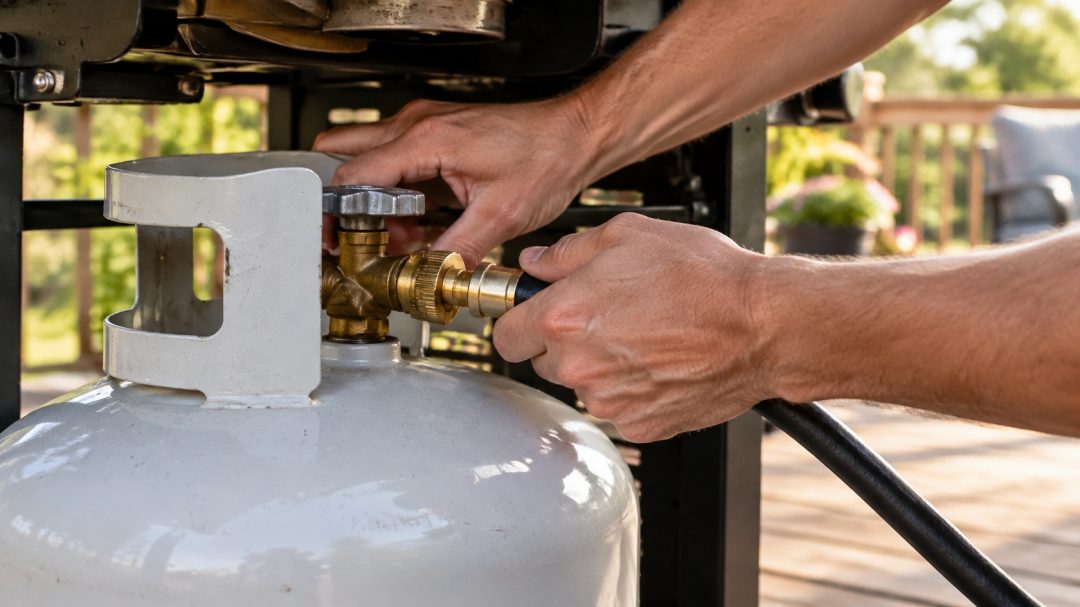
- Connect the regulator securely to the new tank valve
- Perform a soapy-water leak check: Mix one part dish soap with one part water and apply to the valve and hose connections
- Watch for bubbles: Bubbles mean a leak; do not use the tank
- Smell for propane: Propane carries a rotten-egg odor; if you detect it, move away from the area immediately
- Open the valve slowly before igniting the grill
These steps take less than two minutes and make every cookout safer.
Conclusion
Exchanging a propane tank is one of the easiest projects a homeowner can tackle. With a little preparation, the right location, and a quick safety check afterward, the whole process takes just a few minutes and keeps your grill ready for any occasion.
Rocky’s Ace Hardware locations carry Blue Rhino exchange tanks and are staffed by knowledgeable associates who can help you find the right supplies for grilling season and beyond. Stop by your local Rocky’s to pick up a fresh tank and spend more time enjoying the backyard instead of worrying about running low.
Frequently Asked Questions
How much does a propane tank exchange cost in the United States?
A standard 20-lb propane tank exchange costs between $17 and $25 at most retail locations across the United States. Pricing varies by region and retailer. A survey of consumer savings data found that refilling your own tank can save up to $1.75 per gallon compared to exchanging, making refills the more economical choice for frequent grillers who want to stretch their budget each season.
Where can I exchange a propane tank near me in the United States?
Propane tank exchange locations are widely available across the United States. The AmeriGas Cylinder Exchange program was available at over 41,500 retail locations as of September 30, 2025, including grocery stores, gas stations, and hardware stores, according to Ferrellgas fiscal 2025 filings. Many Rocky’s Ace Hardware locations also carry Blue Rhino exchange tanks. Check with your local store for availability.
How much propane is actually in an exchange tank?
Standard exchange tanks contain 15 lbs of propane, not the full 20 lbs the cylinder can hold. Federal DOT regulations under 49 CFR 173.301 cap legal fill at 80% of tank capacity to allow for thermal expansion. Exchange programs fill to 15 lbs as a standard practice. A Truck Camper Magazine reader survey found that 81.1% of respondents prefer refilling their own tanks, with cost and fill level cited as top reasons.
Is it better to exchange or refill a propane tank?
The answer depends on your priorities. Refilling costs less per gallon and gives you a fuller tank. Exchanging is faster and more convenient, and it’s the best option when your tank is expired or damaged. Most exchange programs, including Blue Rhino, accept expired cylinders as a swap and handle recertification, which a standard refill station cannot legally do for an out-of-date tank.
What do I need to bring to exchange a propane tank?
Bring your empty or low 20-lb cylinder in acceptable condition (no rust, leaks, or visible damage) along with payment for the register. Confirm store hours before you go, since exchange kiosks may be locked outside of business hours. Transport your tank upright and secured in your vehicle. You don’t need any special tools or paperwork. The whole exchange process typically takes just a few minutes once you arrive.